MODEL ON TEST: GR SPORT 1.5 VVT-i HYBRID – MILEAGE – 8,840
Sometimes you find yourself mentally making excuses not to do something. I’ve been known to avoid the dentist, for example, and have repeatedly put off sorting through old pairs of running shoes because – you never know – I might need them one day.
Other times you try to find an excuse to do something, like taking a trip to Toyota UK’s Media Experience Centre. It’s a fancy name, and the facility is beautiful, but it’s what’s inside this top-secret location that really matters. This is where Toyota keeps a glorious array of heritage vehicles, including an AE86, a Mk1 MR2, a 1966 Corona, a K-reg Carina the one-off mid-engined Aygo Crazy and the Hilux that went to the North Pole with Top Gear. Then there’s a Lexus LC 500, RCF, GSF, ISF and – the holy grail – LFA.
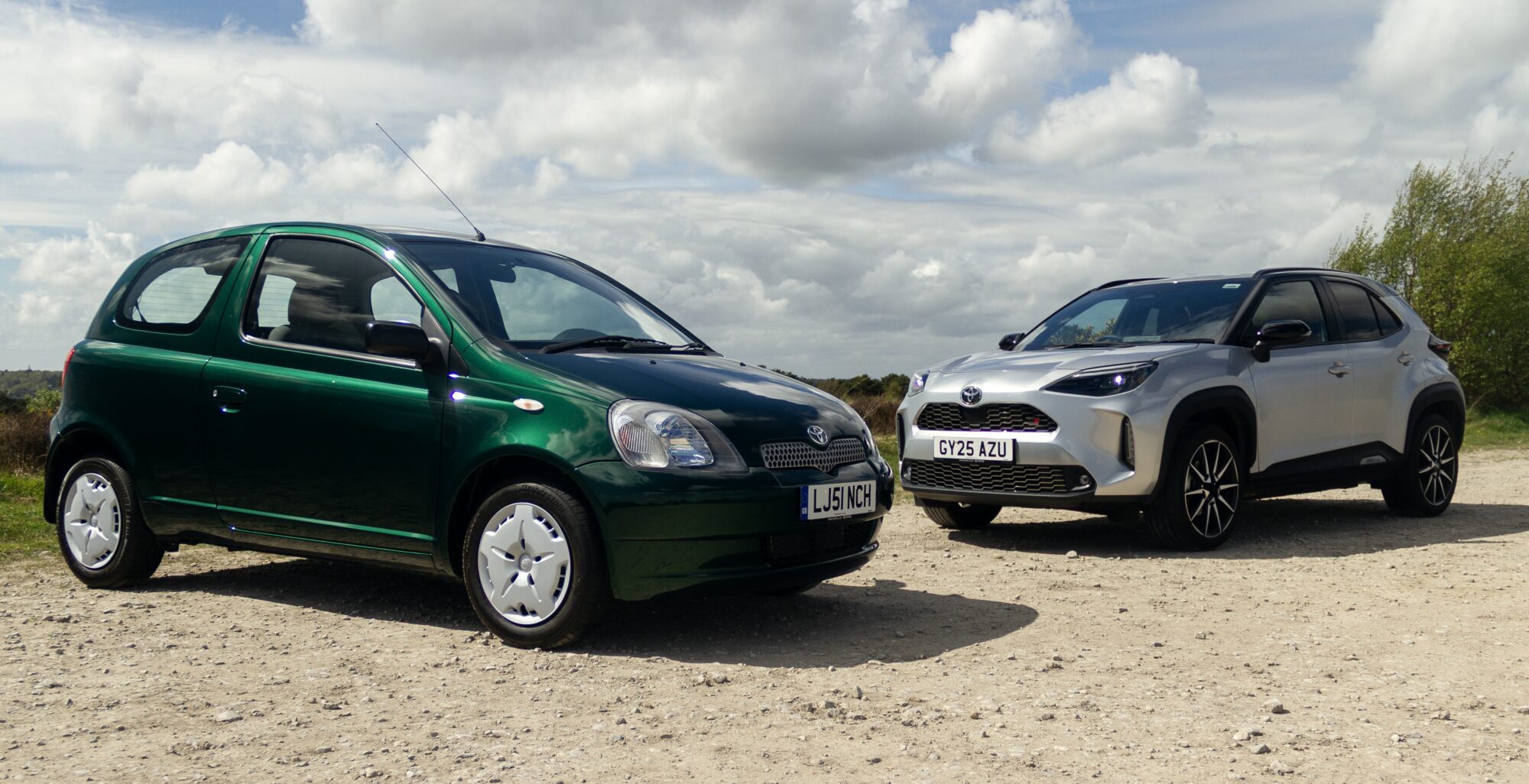
I found myself in this Aladin’s cave recently, sadly not to drive the LFA (I am available to drive it at any point, night or day, if anyone from the Toyota and Lexus PR team is reading this), but to pilot a very special Mk1 Toyota Yaris. Originally registered in Ireland in 2001, it sat stationary until Toyota
UK took ownership a few years ago with little more than 100 miles on the odometer. Now with just over 800 miles under its belt, this is almost certainly the lowest mileage Mk1 Yaris in the UK. Which begs the question, how does it compare to our very own Yaris Cross, now with more than ten times the mileage of the dark green time capsule?
Jumping into the 2001 Yaris is like stepping back in time. Aside from the jazzy seat upholstery, there’s no central touchscreen, the steering wheel is button-free, and there’s both manual mirror adjustment and a proper handbrake. There’s also a tape deck, physical controls for everything and an ashtray. By contrast the Yaris Cross is jam-packed with technology, but Toyota still blessed the dashboard with physical controls for the air conditioning. There are no funky haptic controls, either, with good old-fashioned buttons on the steering wheel rather than the cheaper to manufacture, touch-sensitive pads fitted to some cars.
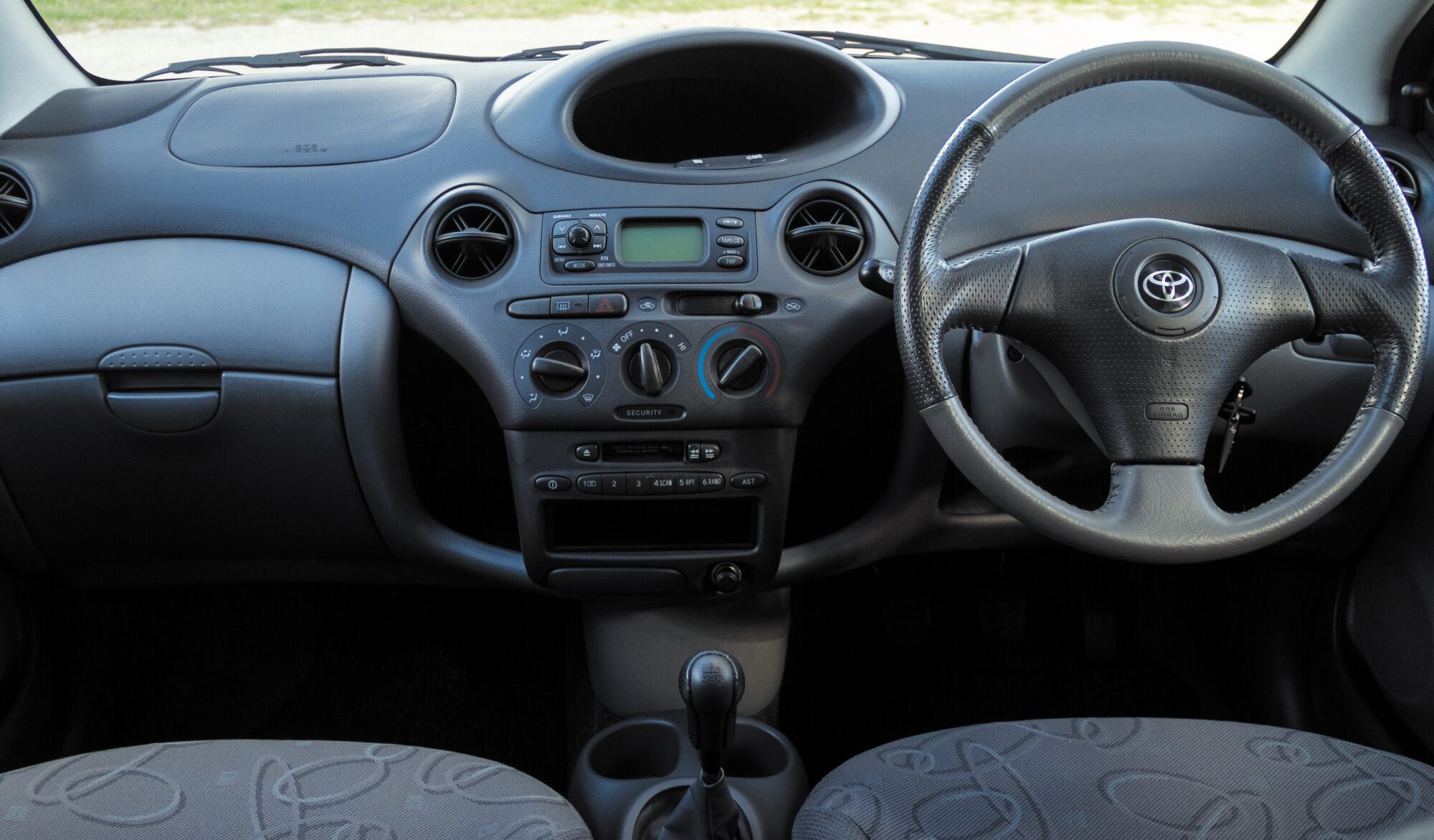
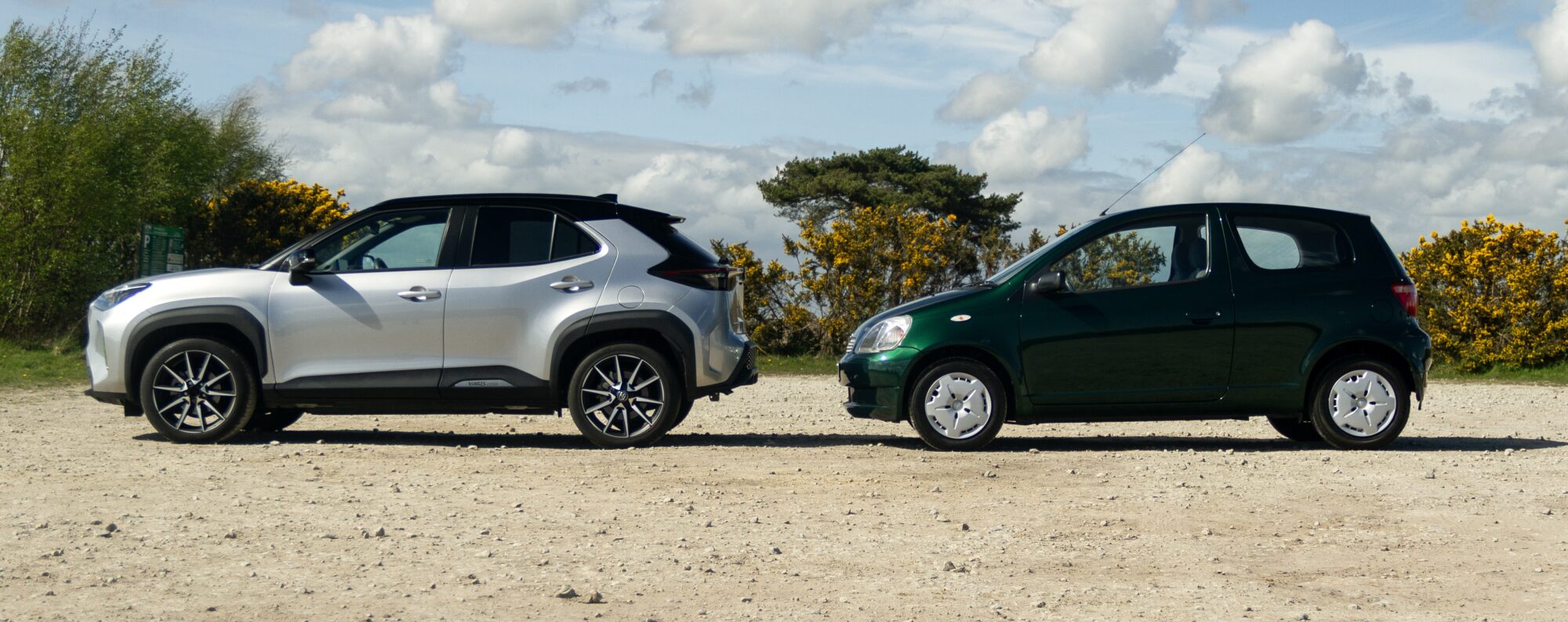
Beyond the interior, the most obvious contrast is the size. The Electric Green Mica Yaris isn’t a big car at all, measuring 3.6 metres long, 1.6 metres wide and 1.5 metres tall. But with thin A-pillars and a rear-view mirror perfectly sized for you to see the view out of the rear window and nothing of the rear seats or parcel shelf, you don’t feel cooped up or cramped – there’s a pleasant sense of space, despite the tiny footprint. The Yaris Cross, meanwhile, affords a good view out front and out back, but it doesn’t feel as open or bright. In actual fact,Toyota left interior space on the table with the hatch, as there’s a little shelf for sweets and road maps below the steering wheel, then two lung-shaped storage bins either side of the dashboard. There’s not one but two gloveboxes for the passenger, too, one opening downwards and one opening upwards, even with dashboard-mounted airbags.
What about the driving experience, I hear you ask? Things do feel very different, it must be said. The Yaris Cross is a well-sorted car, with a largely smooth ride and a predictable if not communicative feeling from the electric power steering and the brake pedal. But the Yaris, particularly with its hydraulic power steering, is a reminder of how joyous a very simple, older car can be to drive.
The steering weight in the dinky green Yaris is nice, whether you’re manoeuvring in a car park or mooching along an A-road. But more than that, there’s a constant background level of chatter coming from the road surface to your hands. I’m aware that sentence could put me in strong contention for the Auto Journalist Cliché of the Year Award, the sort of thing usually reserved for someone who writes about how the steering feels in a 2008 997.1 Porsche 911 GT3 RS is like “touching the road with your fingertips”. But jumping from an old car into a Yaris Cross reminds you how things have moved on and how you’re a little more isolated.
The Yaris’ five-speed manual gearbox is quite entertaining, while the brakes – complete with ABS – are just about fine, even with rear drums and dinky front discs.The ride is decent, too, no doubt a combination of the circa-820kg kerb weight and suspension which, let’s face it, is as good as new. All of this gives you the confidence to enjoy a nice open road, even if you’re not travelling particularly quickly…
Speed is one area where both the new and the old do not excel.Thrash the original Yaris (which I didn’t, because that would be a crime with less than 1,000 miles on the clock) and you’ll hit 62mph in 14.1 seconds. Pin the throttle in the Yaris Cross and you’ll do the same sprint in 11.2 seconds.
But neither car was built for performance. Frugality is the name of the game, and – on paper – the two aren’t very far away from each other, the original claiming 50.4mpg, and the latter machine 62.7mpg. Similarly, they produce 134 and 112g/km of CO2 respectively. Yes, how cars are tested for fuel economy and emissions has changed a lot in the last 20 years, but both are efficient little creatures.
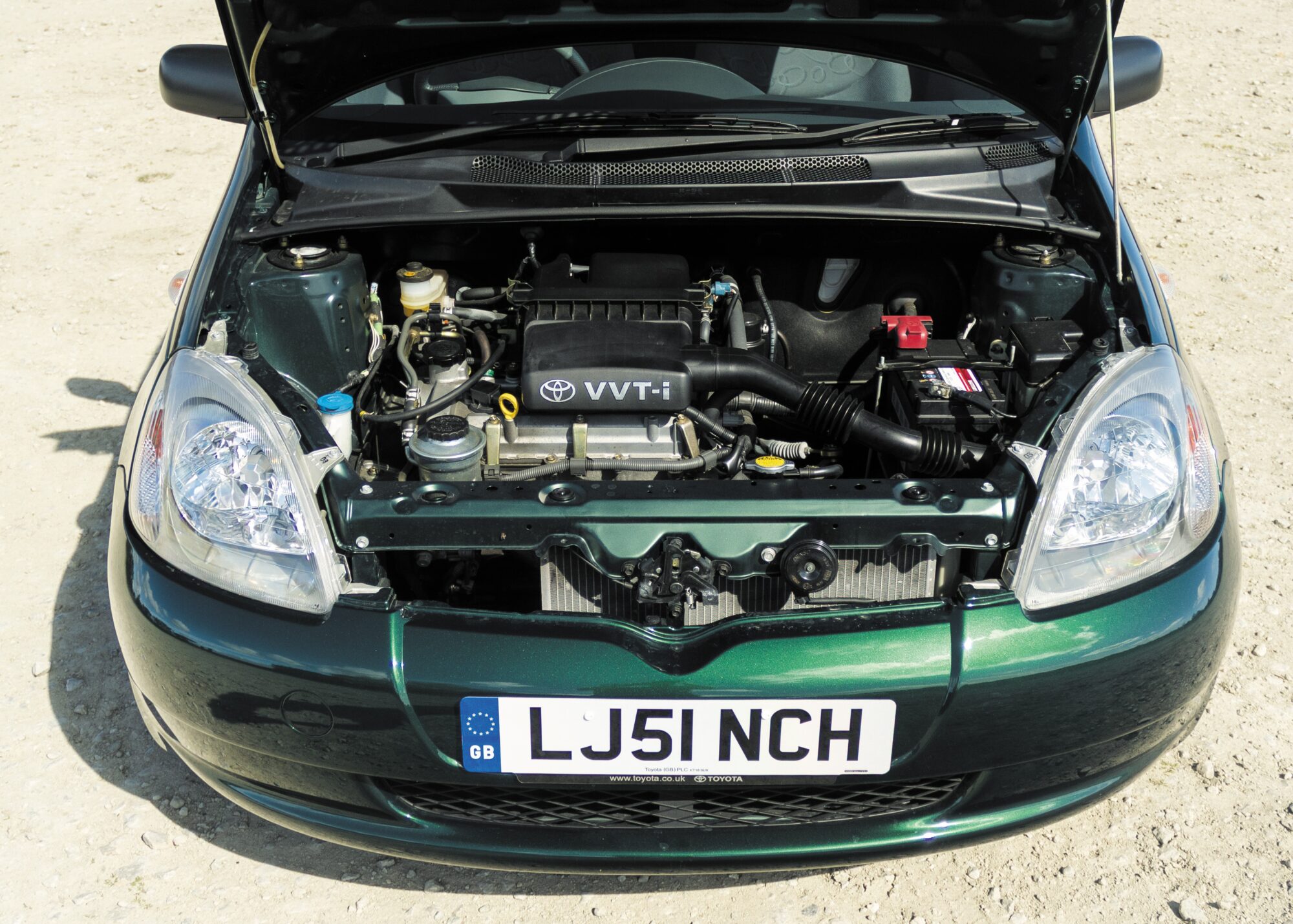
Most interesting to me is how the original Yaris has a very zippy throttle response from its slightly coarse- sounding, 1.0-litre, four-cylinder ‘1SZ-FE’ engine. In comparison, the Yaris Cross and its hybrid, 1.5-litre, three-cylinder ‘M15A-FE’ unit doesn’t offer the same nippy response, no doubt thanks
to the CVT gearbox that blunts the ambience somewhat.
I could go on talking about various similarities and differences, of which there are many, as you’d expect.
But what was genuinely fascinating is how both of them feel like Toyotas. I’m confident that will read as
the most obvious sentence in this month’s magazine. But a number of new cars carry historic nameplates, and some feel like they’ve been made by totally different companies.
The primary reason the Yaris and the Yaris Cross feel so similar is the simplicity of their execution.
In the Yaris Cross, there are no huge jazzy infotainment screens or animations.There are no quirky textures across the interior.There’s nothing particularly exciting or ‘out there’. Similarly, the original Yaris is
a basic hatchback that has what you need and nothing more.The wildest part of the interior is the LCD instrument display that recedes into the dashboard, but it doesn’t feel like a gimmick in the slightest.
Before our Yaris Cross arrived late last year, I couldn’t understand why it held a Yaris badge. Now, having driven this pair back-to-back, they might be different cars separated by more than two decades, but they’re both cut from the same cloth.
SEÁN WARD
WHAT’S HOT: The Yaris badge remains unchanged after more than two decades.
WHAT’S NOT: Why can’t modern cars have tape decks and no screens?
CLICK HERE TO READ ALL OF OUR LONG-TERM REPORTS ON THE TOYOTA YARIS CROSS
FACTS & FIGURES
ARRIVED: 14th November 2025
PRICE WHEN NEW: £32,245
PRICE AS TESTED: £32,245
ECONOMY: 58.8mpg (official WLTP) 54.4mpg (on test)
COSTS: None
FAULTS: None
© Motorworld Media 2023
Registered Office: 4 Capricorn Centre, Cranes Farm Road, Basildon, Essex. SS14 3JJ
Company Number: 8818356
Website designed by Steve Dawson