MODEL ON TEST: ULTRA T8 PLUG-IN HYBRID AWD AUTOMATIC – MILEAGE – 5,050
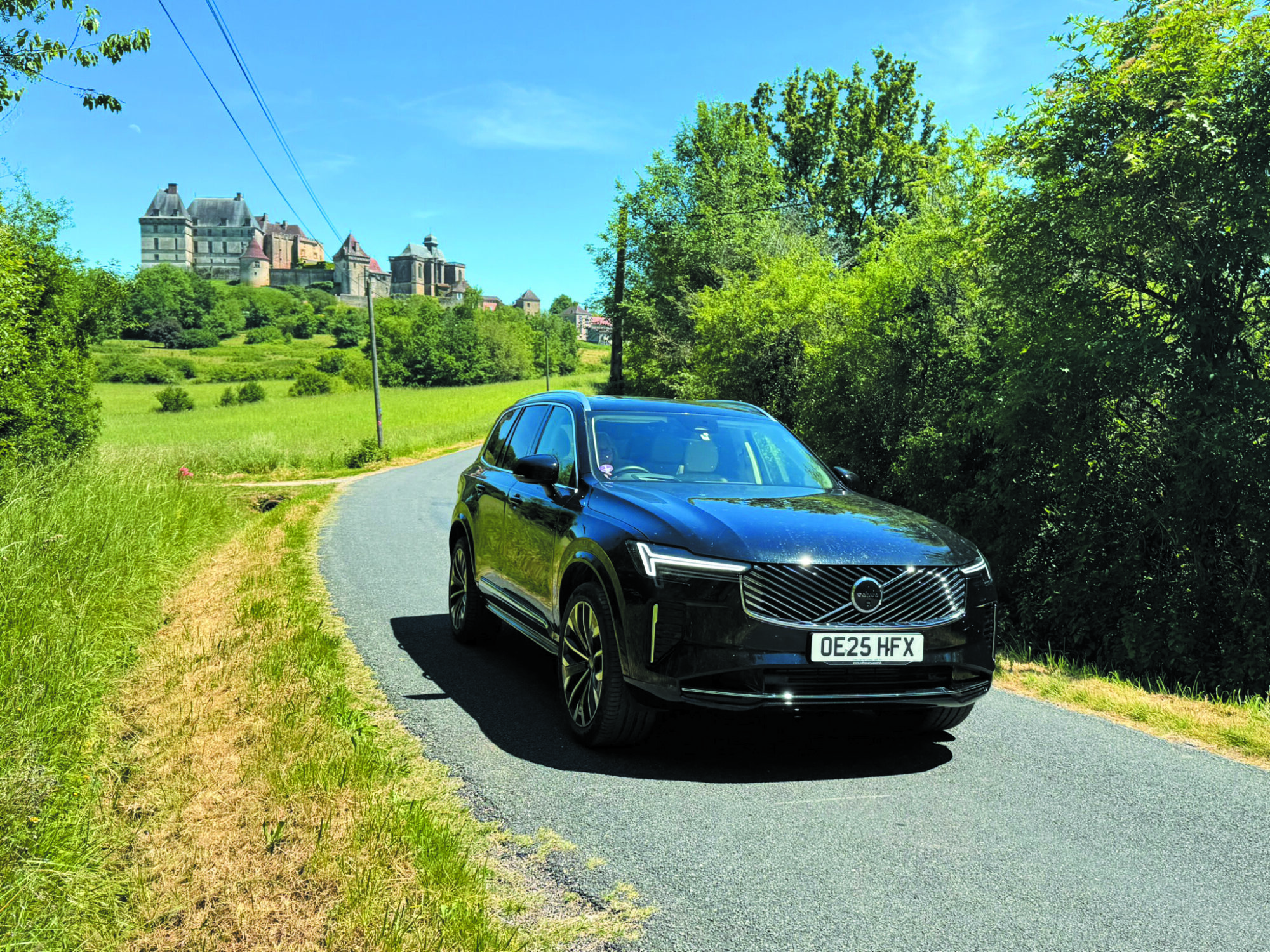
SO how to put a big SUV – claimed by its makers to be ‘ready for anything’ and by reviewers to be ‘almost perfect’, ‘sophisticated’, ‘highly practical’, ‘luxurious’, ‘refined’, ‘even ‘calm’ – to the ultimate test? The best and certainly most enjoyable challenge I could think of was to load it with tons of luggage, along with my wife and Fergal our mini-Schnauzer, and head off for a grand, three-week tour of France.
I’d like to have made it up as we went along, stopping in pretty villages and hotels on a whim, but as it clashed with half-term, we played it safe and booked ahead, our chain of carefully chosen hotels and B&Bs stretching from the Opal Coast in north-west France, right down to just south of Toulouse in the Occitanie region, with multiple stops enroute. A road trip is, for me, the best kind of holiday, especially if you don’t need to fly to the starting point.Who likes airports or sitting for hours in a pressurised cylindrical tube, cheek by jowl with other travellers.
Me? I love the freedom of driving, letting the car talk to me as I slowly uncover its strengths, weaknesses and secrets, while discovering what’s around the next corner. In particular, I wanted
to see how the Volvo would handle hundreds of miles of autoroute in one go, and then the little, winding back roads that we knew we’d be following into myriad medieval villages, steeped in enchanting history. The French particularly like their smaller, home- grown cars; how would the big XC90 feel in those tightly packed market squares, narrow country roads and in the hotels’ underground car parks? We’d soon find out…
Our launch-pad was LeShuttle in Folkestone. It’s handy, as they have efficient pet-checking facilities, to ensure your dog’s jabs and so on are up to date before allowing them into Europe. Your journey through the tunnel is hassle- free and over before you know it. It’s easier than wrangling your dog (and its various bodily functions) on to a ferry. Just 35 minutes after leaving the UK we were disgorged (with a cheery wave from a crew member) onto efficient, fast- flowing roads linking us, via a network of autoroutes and dual carriageways, with the rest of France, seemingly melting in a heatwave.
It felt like quite a test. Most of our trips in the Volvo have centred on London. Now I wanted to assess crucial aspects of its performance: its comfort and quietness at higher autoroute speeds, the efficiency of its climate control as we headed south, its handling on swooping mountain twisties, its fuel consumption when it wasn’t being plugged in (what’s the point, if a charge delivers only around 30 miles and you’re doing 300 or more in a day?) whether its much-vaunted technology (it’s loaded with various goodies claimed to make driving easier and safer) would make any difference and, critically, its load- carrying capacity.
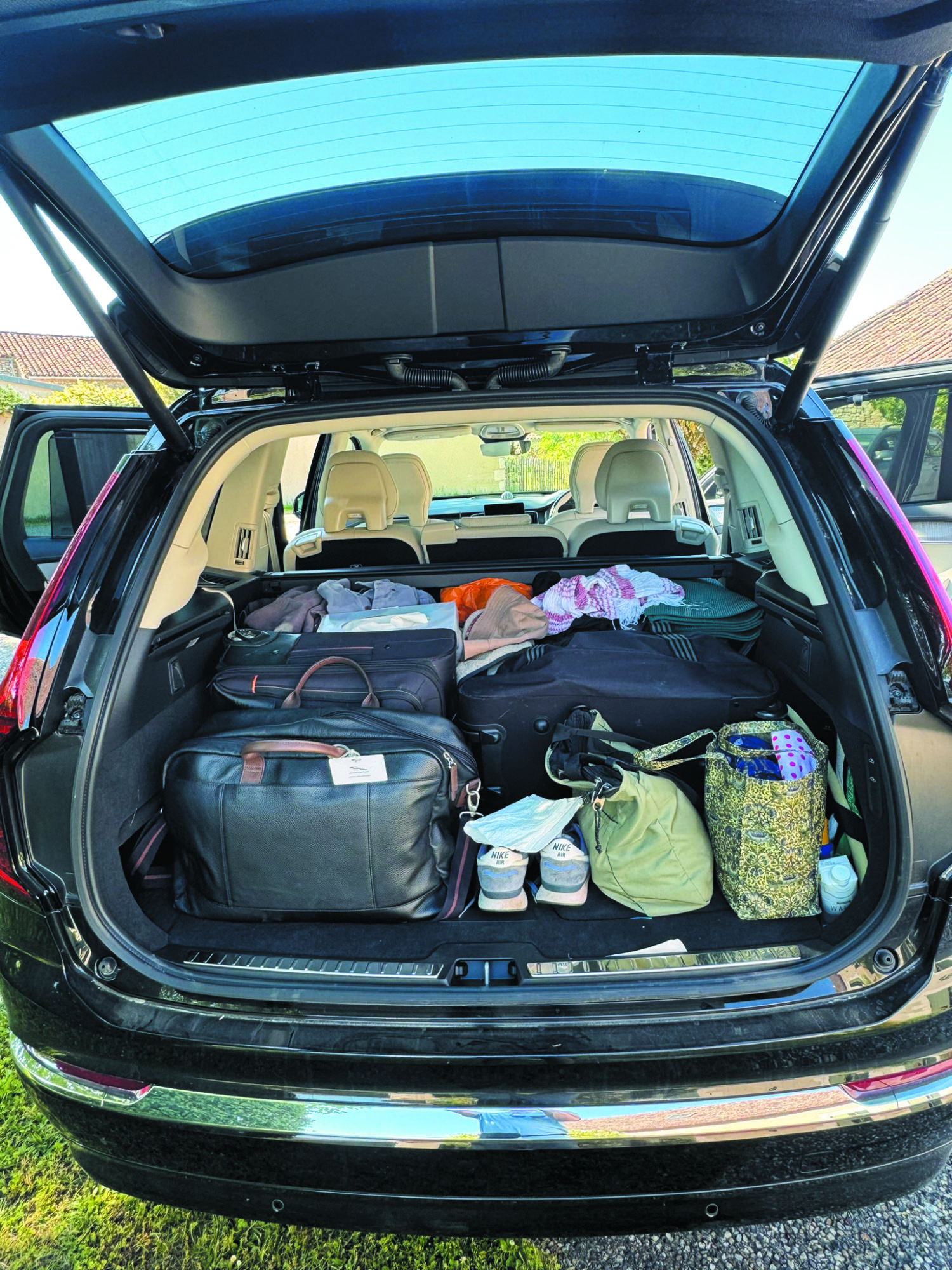
We’re chronic over-packers and – with three weeks on the road – we’d each stuffed one of those giant ‘clamshell’ suitcases-on-wheels with clothes, another two holdalls with trainers, river shoes and sandals, another with wet weather and canoeing gear, another for books/laptops/chargers/ plug adaptors/binoculars, another for Fergal’s needs and so on. Knowing we’d not be using the third row of seats, we slid the middle row as far forward as it would go and clicked the seats upright, creating a load area big enough for a house move. Usefully, this also created a deep ‘trench’ running the width of the car, behind the middle row and in front of the headrests of the folded-down rearmost seats, in which I hoped to stash several cases of the good French stuff that comes in bottles.
The first bit of XC90 technology to come in handy was the ‘units’ setting on the central screen, quickly switching us from mph to kph. I didn’t want to get done for speeding, after all.
The second piece of useful technology was adaptive cruise control.The joy of autoroutes is that you can generally cruise at 130kph (110 when it’s raining); equating to nearly 81mph; a far happier cruising speed than we’re allowed in the UK. ACC takes the strain out of the driving and the XC90’s generally works well. The one peril of driving in France is that tailgating appears to be a national pastime. Set your ACC speed at 130kph, dial in the maximum safe distance from the car in front… and it drives some French motorists mad. So close do they sit to your rear bumper that you feel compelled to pull over to the right to let them fly past…. only to find that they, too, pull in. Still inches from your rear bumper.
On long autoroute days, fuel consumption tended to drop to around 31.2mpg, returning to around 32mpg on days when we pottered around on slower roads. The hush at high speed was impressive, with just a little buffeting from the A pillars. Swapping seats with my wife on big driving days, it was handy to have the memorised seating positions on both front seats. Lovely too, as the thermometer hit the high 30s, even hitting 40-degrees Celsius at one point, to have the cooling seats switched on permanently. We found that the middle of three settings was sufficient on the hottest days; the top setting was a little too noisy.
Most of the time we set the air conditioning to ‘low’ and it cooled the car perfectly, especially if we closed the swish, electrically controlled interior blind covering the great panoramic sunroof (which came into its own as a viewing ‘platform’ when negotiating dramatic gorges and mountain roads, and low- slung underground car parks). On the hottest days, we put the fan up to the second position (of 5 settings), rarely needing to go any higher. I also loved the ‘global opening’ function; hold down the key fob button when approaching the parked car on a hot day and it opens all the windows, releasing the hot air before you climb in.
Fergal was comfortable too thanks to jets of cold air, not just from two directional vents on the back of the armrest, as he sat on the back seat, but also from additional directional vents built into the B pillar, directed at his basket. Passengers are well catered for as you’d expect in a family seven-seater; there are also additional vents for the third row. We also pulled up those great rear window blinds that Volvo provides, to keep Fergal in the shade.
Other ‘likes’ on this luxurious family SUV? Plenty. The ride quality from the air suspension is superb and even better damped at the rear when heavily loaded. The other advantage is that it’s possible to lower the suspension with a switch in the boot, making it easier to hoist those ridiculously overpacked suitcases into the back.
The Bowers and Wilkins hi-fi system is a blast.When sitting in the passenger seat, I fiddled endlessly, playing with the surround sound, choosing different ‘studios’ (jazz, concert hall etc.). I delved into the glovebox and found that Volvo supplies special leather treatments; one to clean the leather upholstery, another to nourish it. Do they think of everything at Volvo?
The navigation worked brilliantly, projecting not just on the big central screen, but also on the instruments directly in front of the driver, as well as being flashed up onto the windscreen head-up display. Not much chance of going wrong. But we did of course, here and there; the visual instructions could be a little slow to react at roundabouts.
Fearing headroom problems in one very cramped hotel car park, I discovered that by selecting Power
or Pure on the Drive Modes panel, I could ‘slam’ the suspension by around two centimetres; useful to know. More exciting yet, as we struck deep into the countryside in search of a remote place to swim in a local lake not far from Toulouse, I returned to Drive Modes and discovered that in addition to the permanent four-wheel-drive mode, there’s a dedicated Off-Road mode I’d not seen before (not much call for it in London). This raises the car by around four centimetres, and firms up the suspension. Suddenly, it’s all very butch. You feel invincible, like driving a Land Rover, giving us confidence on steep, uneven tracks. What a great feature; it was also handy when – on particularly tight backroads lined with grass verges – we were able to edge off the tarmac to let other vehicles past, just as they did for us.
France became more French the further south we drove, but from the off, we admired the nation’s sense of pride and community. Enter almost any village and you encounter lovingly tended flower beds, neatly mown verges, free dog poo-bag dispensers everywhere, little litter and seldom any graffiti. Even the roundabouts are well-tended, rather unlike those in the UK. First, we dallied in pretty Trouville and enjoyed the beach, before heading for beautiful Loches, in the Loire. Next up was a serene B&B
in the Dordogne, where we had no trouble piloting the XC90 in and out of mesmerising, compact, labyrinthine medieval villages.Then came Figeac, also in the Occitanie region, giving us the opportunity to drive along gorgeous, winding gorges in search of river- swimming spots and (more) medieval chateaux. Next up was a tiny village just south west of Toulouse, that was just as beautiful and with endless country roads just as good for driving as we’d half remembered from 27 years earlier when we were last here, when my wife was expecting our twins.
The ‘Brake’ setting, on the gearshift, offering extra regenerative braking came into its own when we headed north again into the Tarn valley. Descending extremely steep mountain roads into La Malène, it made negotiating the tight, steep, hairpin bends easier and topped up the batteries nicely for manoeuvring around when we reached the bottom. Cleverly, given that speed limits on autoroutes and some other major roads drop when it rains, I was intrigued to find a ‘rain’ symbol appearing on the dashboard when the weather changed, together with the lower speed limit, in the Volvo. I realised it was activated by the wipers. Clever stuff. With all these gadgets, all the comfort, all the space, I really was impressed with the XC90 Ultra, to the extent that I started researching how much the insurance would cost if I bought it, instead of handing it back to Volvo at the end of the trip…
The only ‘blip’ came on a dual carriageway where I diligently set the ACC to precisely 110kph, only for the Volvo to momentarily speed up as it finally crested a long, steep hill, nudging us sufficiently over the limit to get me flashed by a craftily-placed speed camera. Driver error, maybe, as my wife suggested? I don’t think so, but can’t be positive. We’re waiting to see if it will be followed up, but nobody will believe it’s the car’s fault even though I had been driving in a leisurely fashion throughout our grand tour. I doggedly stuck to all the speed limits in town and on the main roads while all around were overtaking like mad to get past.
Possibly the biggest tests for the Volvo were the whole-day legs we factored in to drive back via pretty Clermont Ferrand, then Chinon (where we bought a ton of wine) and on, up to the fascinating, historic town of Montreuil- sur-Mer, not far from Calais. We enjoyed every minute behind the wheel, enjoying the sense of power, luxury and comfort, aided, of course, by the massaging front seats, nice fluid steering, the glider-like ride and that king-of-the-road sense you get in a tall SUV.
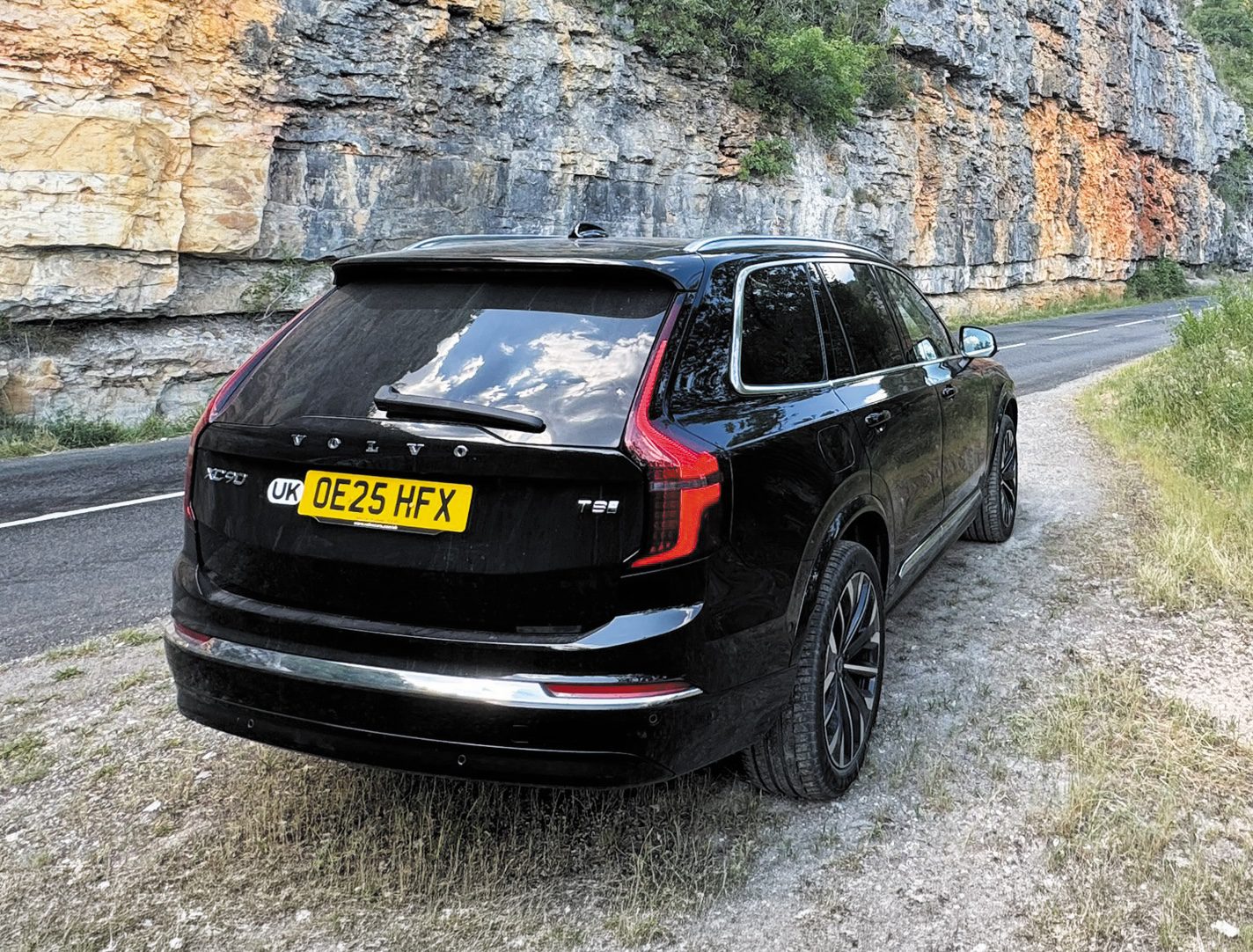
At our final stop in fascinating Montreuil-sur-Mer, with its mighty, centuries-old fortifications and myriad historic buildings, GHQ for the British Army in France in WW1, then a garrison for the Germans in WW2, we had a bird’s-eye view from our hotel window as – unbelievably – no fewer than 27 beautiful old ‘70s Citroën SMs, with their hydropneumatic suspension and V6 Maserati engines, crept, crunched and burbled into the gravel car park on a club tour. It was a joy to peer out of our window as, bonnets up, cameras clicking, owners and passengers happily chatted, compared notes and gently revved their engines.What a sight.What a sound. I was just as happy, however, peering out at the handsome lines of the big, sleek, black Volvo that had so effortlessly conveyed us over more than 2,000 miles of some of the best scenery Europe has to offer.
I bought an Emovis-Tag, which, after being mounted in the windscreen is automatically read by toll booths on autoroutes, saving you from having to stop. It feels like magic as you approach at around 30kph, there’s a beep from the unit, and the barrier swings up. Payments come straight out of your account. Much easier than stopping to feed coins into the machine.
Remember that old Remington shaver television advert when the boss drawls: ‘I liked the shaver so much, I bought the company’? I now aim to do the next best thing. Clearly, I can’t afford Volvo Cars itself (as far as I know, owners Geely Holdings aren’t selling it) but I would like to dip into my hard-earned pension and buy the XC90 as a ‘keeper’, if the price is right. I’ve made enquiries and wait to hear back. What draws me to it? I like the space as we sometimes venture on holiday with our grown-up kids and their partners, along with our dog and theirs. I love its practicality, its palpable air of luxury, its power, the fact that it has AWD (especially with that off-road mode), its great looks and all the gizmos. Negatives? The four-cylinder 2.0-litre engine’s not the most refined sounding when revved, but I’m not a fast driver these days and keep it low revving (I do miss Volvo’s old five- cylinder units). I hadn’t, in truth, wanted a plug-in hybrid (the cables are a faff in the rain, they take up boot space and the whole car ends up heavier). But under Lambeth Council’s daft residents parking permit rules, while the mild hybrid version would cost a whopping £394.27 a year just to park outside my house, the T8 plug-in hybrid would cost ‘just’ £135.37. Quite a difference. The T8 also has more power, and I like gliding around town on electric-only in town; it feels even more refined. If things work out, it could be a long, happy relationship. Especially when we head for France and all those caves à vin.
DAVID WILLIAMS
WHAT’S HOT: What could be sleeker than your own, personalised, in-car, tree-by-tree air quality report?
WHAT’S NOT: The four-cylinder 2.0-litre petrol engine performs well but lacks the refinement of Volvo’s old five-cylinder units.
CLICK HERE TO READ ALL OF OUR LONG-TERM REPORTS ON THE VOLVO XC90
FACTS & FIGURES
PRICE: (NEW) £84,260
PRICE: (NOW) £83,760
PRICE: (AS TESTED) £85,055
PRICE: (DEALER TRADE-IN) £52,900
PRICE: (DEALER FORECOURT) £56,100
COLOUR: Onyx Black
BUILT IN: Torslanda, Sweden
CODENAME: V526
GENERATION: 2 Facelift 2
PLATFORM: SPA
BODYSTYLE: 5-door SUV, 7-seats
LAYOUT: Four-wheel drive
POWERPLANT: 1,969cc, 4-cylinder, 16-valve, turbocharged petrol with electric motor and 18.8kWh battery pack
GEARBOX: 8-speed automatic
MAX POWER: (ENGINE) 228kW/306bhp/310ps @ 6,000rpm
MAX POWER: (ELECTRIC MOTOR) 107kW/143bhp/145ps @ 15,900rpm
MAX TORQUE: (ENGINE) 295lb ft/400Nm @ 3,000-4,800rpm
MAX TORQUE: (ELECTRIC MOTOR) 228lb ft/309Nm @ 0-3,280rpm
TOP SPEED: 112mph
0-62MPH: 5.4secs
CO2 EMISSIONS: 32g/km
ECONOMY: (COMBINED) 217.0mpg
ECONOMY: (ON TEST) 31.9mpg
FUEL TANK: 71 litres
RANGE:(ELECTRIC RANGE) 42.9 litres
INSURANCE GROUP: 43
BIK RATE: (2026/2027 TAX YEAR) 10%
SIZE: (LENGTH/WIDTH WITH MIRRORS/HEIGHT/ WHEELBASE) 4,953/2,140/1,772/2,984mm
BOOT SPACE: (7/5/2-SEAT) 244/977/1,941 litres
KERB WEIGHT: 2,295kg
TOWING WEIGHT: 2,400kg
EURO NCAP RATING: Five stars
SPARE WHEEL: (FULL-SIZE/SPACESAVER/RUN-FLAT/ SELF-SEALING/REPAIR KIT) No/no/no/no/yes
WARRANTY: 3 years/60,000 miles
DATE ARRIVED: 18th December 2025
COSTS: None
FAULTS: None
© Motorworld Media 2023
Registered Office: 4 Capricorn Centre, Cranes Farm Road, Basildon, Essex. SS14 3JJ
Company Number: 8818356
Website designed by Steve Dawson