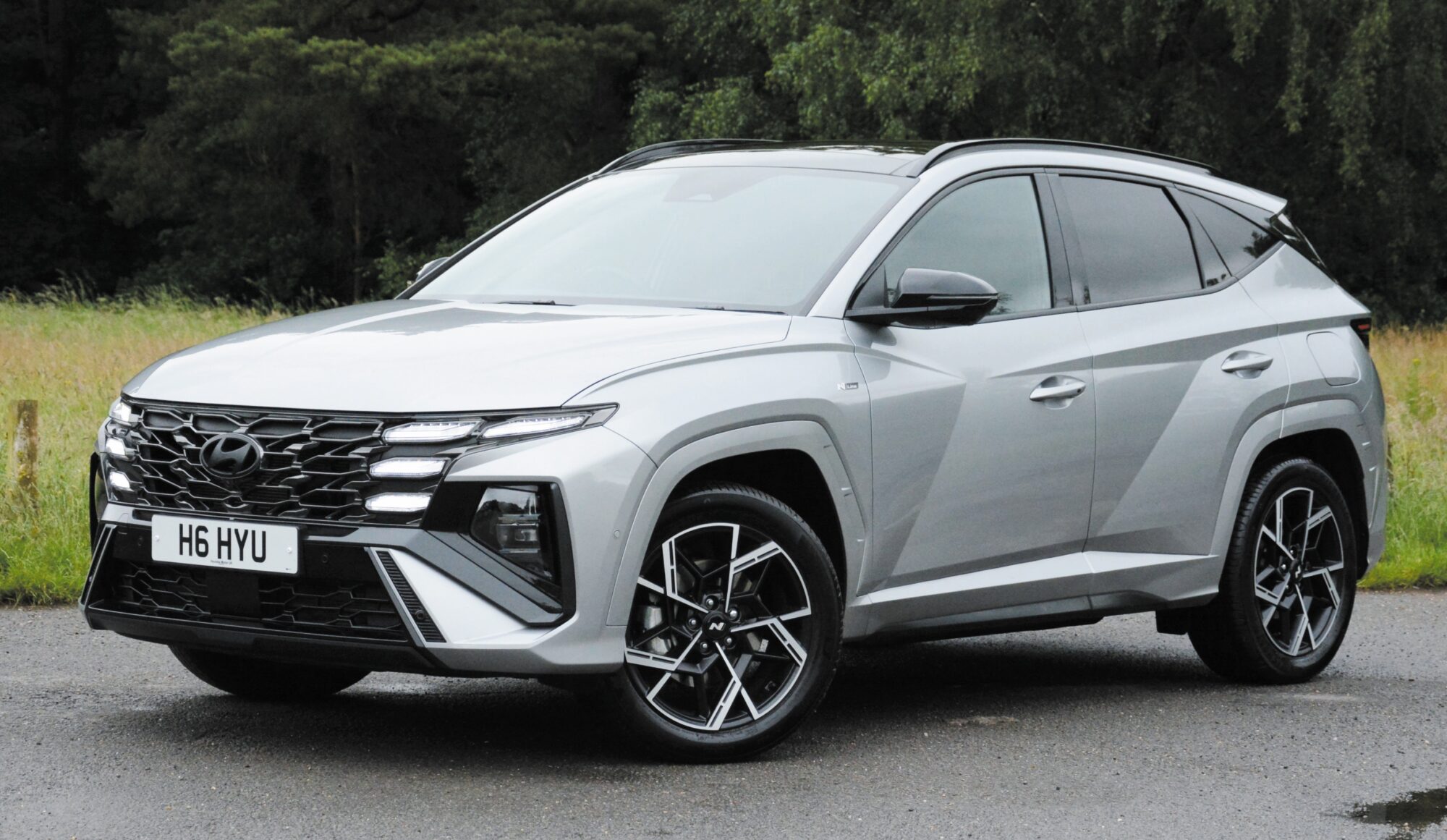
MODEL ON TEST: N LINE S 1.6T HYBRID AUTOMATIC – MILEAGE – 1,032
Spending the past month with a Hyundai Tucson Hybrid has exposed me to a high risk of developing RSI in my right wrist. Not through any design flaw or issue with the car, I hasten to add, just my own brand of madness and this SUV’s well- deserved popularity. At the root cause is that my own two cars are relatively infrequent sights on the roads: an original Renault Scénic and a BMW i3. Spot one heading
in the opposite direction and I feel duty-bound to wave at their drivers, who usually respond in kind.
I’d become so familiar with the Tucson within 24 hours that I’d started to wave at those at the wheel of others I spotted, something made all the easier by its distinctive daytime-running light pattern and because they’re seemingly everywhere. My hand’s been in a constant state of friendly gesture standby and to make my plight all the more uncomfortable, not a single Hyundaist has waved back. Other than to share an unwarranted insight into my driving habits, there’s a serious point being made here: with over a thousand miles covered over a four-week period, that lack of engagement from other Hyundai Tucson drivers is a reflection of how inconsequential any gripes I have about it really are.
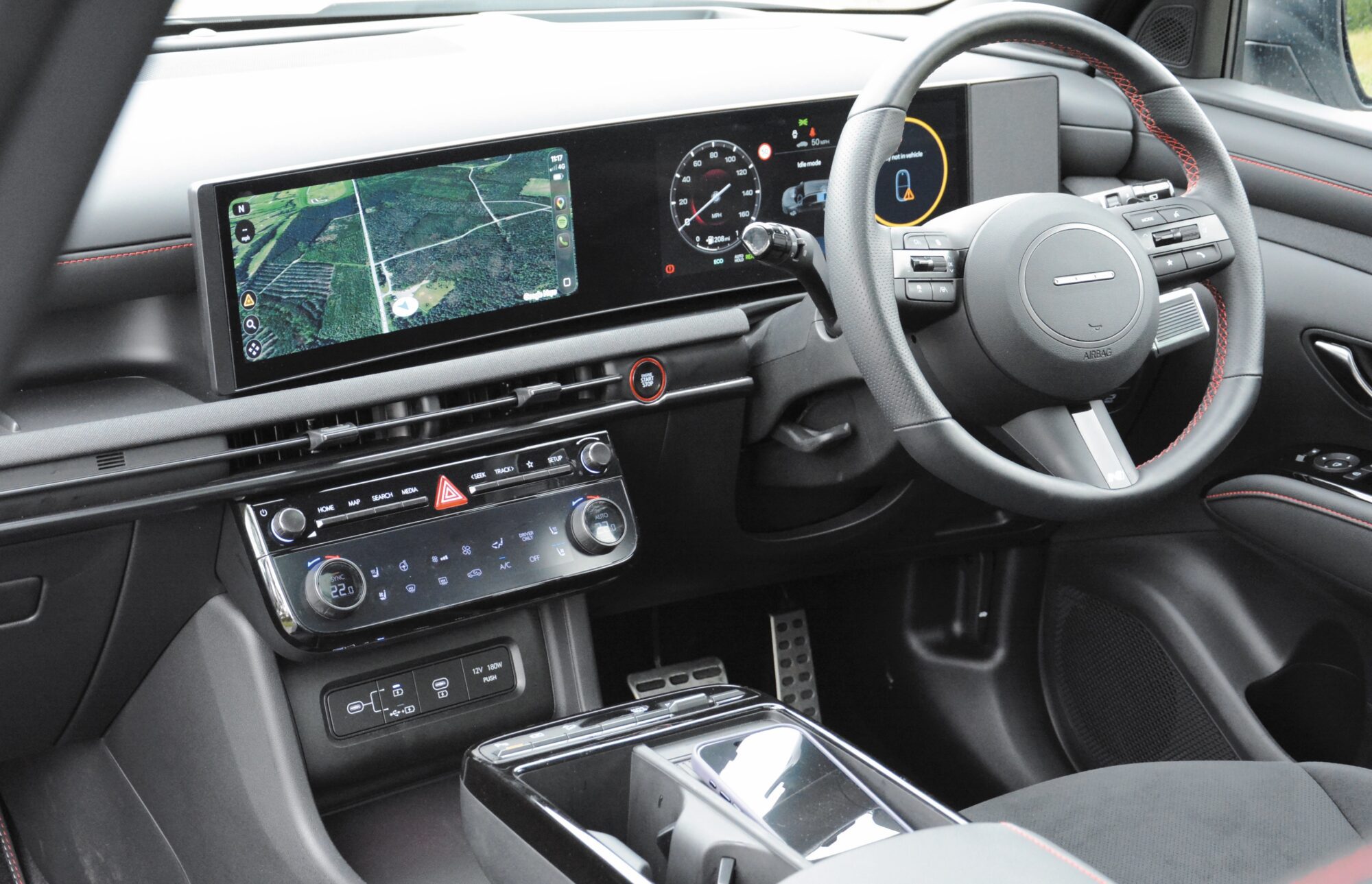
Take its dashboard, for instance – it was given a major overhaul in 2024, with far more dramatic changes than the exterior was subjected to. Out went the twin-cowl scalloping, mildly reminiscent of older Ford Mustangs, replaced by a pairing of 12.3-inch screens set within a gently curved panel. It’s a slick arrangement, with a useful open shelf ahead of the front passenger, an assortment of physical buttons and knobs for all manner of functions, including the dual-zone climate control. And because the centre console-inset pushbuttons for the automatic transmission have given way to a column- mounted wand, there’s more storage space between the front seats. My beef is that I would have liked more curvature to the left side of the touchscreen to make it less of a stretch to operate. Oh, and placing the stop/start button on the drive selector itself, Kia-style, makes more sense.
Space in the back remains generous for two adults, but a little snug for a third in the centre position due to the trailing edge of the centre console impinging on legroom.Taller passengers in the rear may also find their hair getting intimate with the headlining, which is likely more a pain for whoever’s trying to get it out again with a lint roller. The seatbacks also recline, although the more relaxed angles weren’t always a hit with my passengers.
Talking of the rear bench’s centre position, its seatbelt – with two buckles – descends from the roof, just like in my old Scénic, rather than spooling from the top of the seatback. Subscribing to the cliché of car journalists using long-term test cars for tip runs [the Renault was doing old Renault things taking up residence in my mechanic’s yard and have you seen how small the i3’s boot is?], I discovered that the seatback still folds forward with the middle belt engaged, but inevitably becomes taffled in the structure of rotten garden benches and portable clothes rails – or whatever else you discover needs to be ejected from your house.
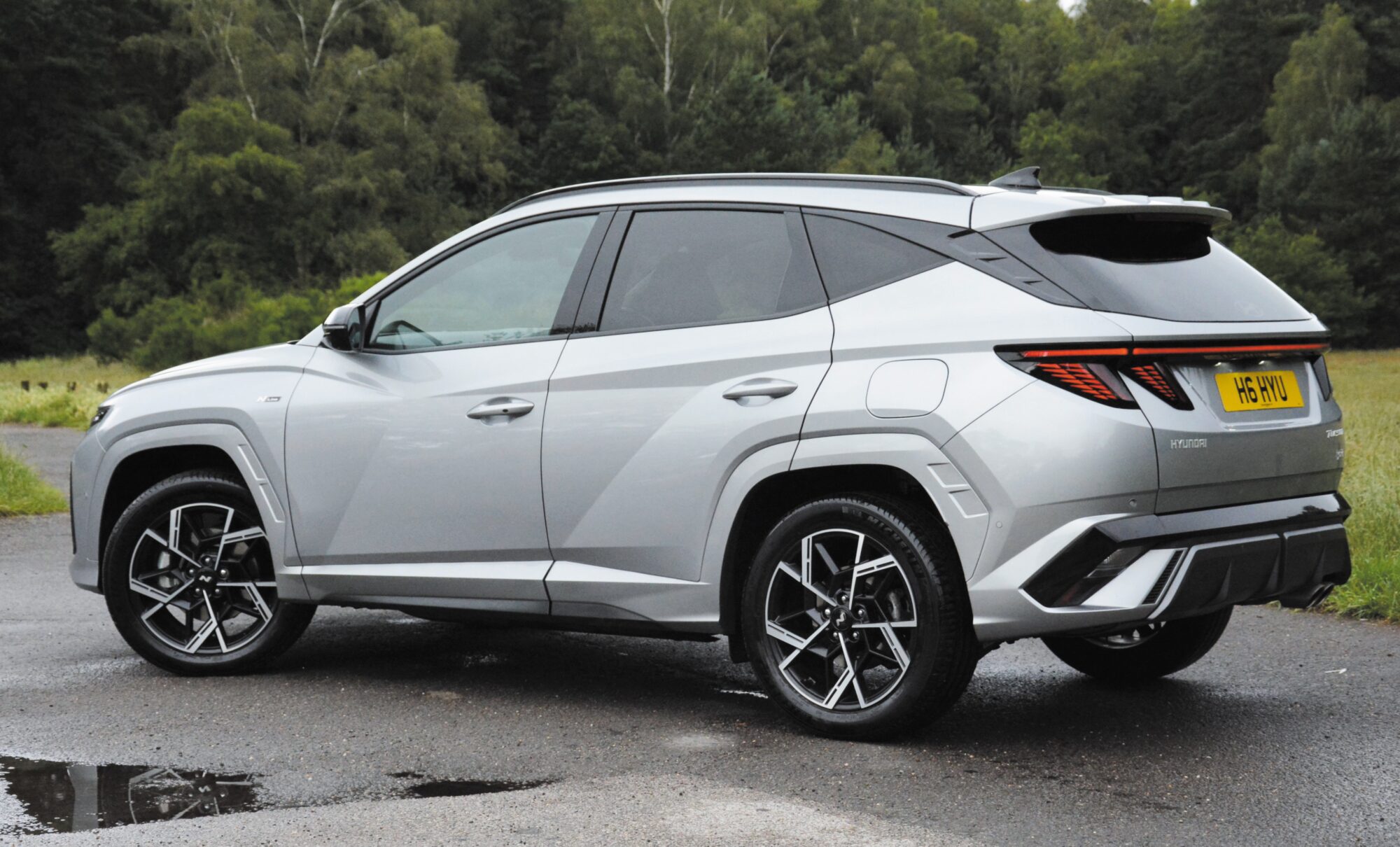
Helpfully, said seatbacks are super-convenient to drop courtesy of levers mounted in the sidewalls of the boot, while they also form a continuous, if not entirely horizontal, plane ahead of the boot floor, making sliding awkward, bulky loads that bit easier.
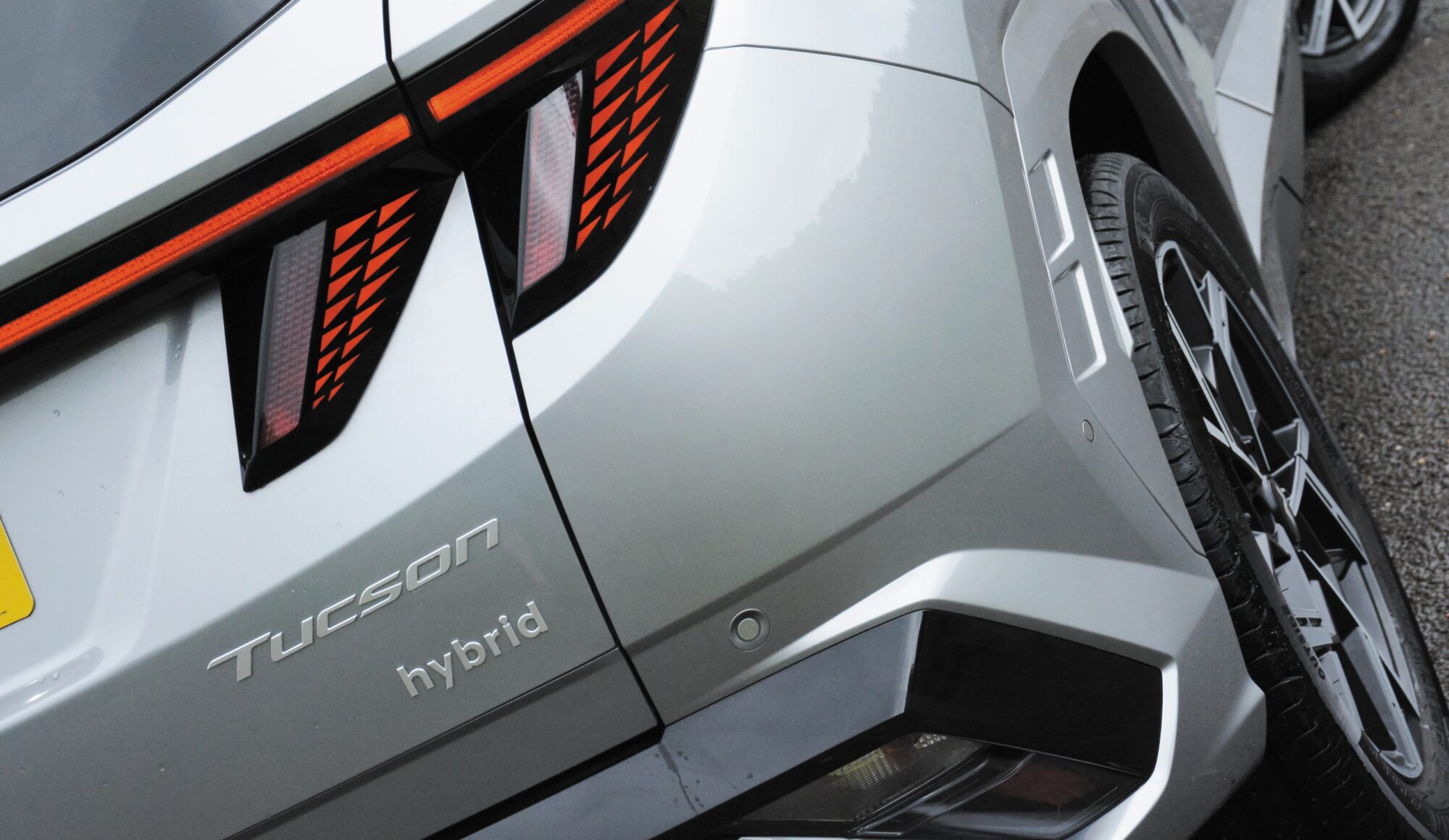
Hyundai’s overhauled the Tucson’s self- charging hybrid system recently, which sees its 1.6-litre turbocharged petrol engine and electric motor combo claim 236bhp of power, 280lb ft of torque and an 8.2-second 0-62mph time, yet also average 48.7mpg on the WLTP combined cycle. I spent the majority of my time with the Tucson in Eco rather than Sport mode as its more relaxed nature felt more in tune with the Hyundai’s easy-going driving style without feeling sapped of its urgency. Doing so typically resulted in long motorway runs realising 42mpg and more urban-centric journeys yielding at least 45mpg.
Only one aspect of the Hyundai’s ADAS safety suite niggled and – unusually for me – it wasn’t the driver attention gizmo. No, here it’s the adaptive cruise control which tends to bug me at motorway speeds due to its preference to scrub a few miles per hour from the car’s speed way too soon. It ‘sees’ a vehicle 100 metres ahead and it commences the pace reduction, even on its shortest distance setting. Dabbing the accelerator overcomes it, but it shouldn’t be necessary.
In short, Hyundai’s recent round of updates for the Tucson – likely its last before an all-new replacement debuts in 2027 – adds further polish to an already accomplished family-sized SUV, thoroughly deserving of the fondness its clearly enjoying from British consumers. But a wave back wouldn’t hurt, would it?
KEITH JONES
WHAT’S HOT: Well-made cabin, improved storage space from facelift, real world efficiency.
WHAT’S NOT: Darker than a goth gathering down a mine inside, over-zealous cruise control.
STANDARD EQUIPMENT:
12.3-inch digital instruments, 19-inch alloy wheels with Michelin Primacy 4 235/50 R19 tyres and tyre repair kit, 40/20/40 split/fold rear seats, 360-degree camera system, Active bonnet system, Adaptive cruise control with stop and go and speed limiter, Alarm system, Ambient lighting with 64 colours, Anti-lock brakes with electronic brake force distribution and brake assist, Auto-dimming rear-view mirror, Automatic headlights, Autonomous emergency braking with pedestrian, cyclist and junction detection, Blind spot warning system DAB radio with 12.3-inch touchscreen, navigation, with 8-speakers, Krell premium audio system, USB-C sockets, voice control and steering wheel controls, Drive mode selector, Driver, passenger, centre, side and head airbags with passenger side de-activation, Electric and heated mirrors with power folding, Electric front seats, Electric park brake, Electric tailgate with hands free functionality, Electric windows front and rear, Electronic stability programme with traction control, Emergency e-call system, Head-up display, Heated and ventilated front seats, Heated rear seats, Heated steering wheel, Hill start assist, ISOFIX child seat safety fasteners for rear outer seats, Keyless entry and start, Lane follow assist, Lane keeping assist, Leather and faux suede upholstery, Leather steering wheel, LED daytime running lights, LED Matrix headlights with adaptive high beam assist, LED rear lights, Panoramic glass electric roof, Parking sensors front and rear, Rain sensing windscreen wipers, Rear cross traffic alert, Rear privacy glass, Roof rails, Traffic sign recognition, Trailer stability programme, Tri-zone climate control, Tyre pressure monitors, Wireless Android Auto, Apple CarPlay and Bluetooth smartphone compatibility and Wireless smartphone charger
OPTIONAL EQUIPMENT FITTED TO TEST CAR:
Shimmering Silver metallic paint (£750)
FACTS & FIGURES
PRICE: (NEW) £41,345
PRICE: (AS TESTED) £42,095
COLOUR: Shimmering Silver metallic
BUILT IN: Nošovice, Czech Republic
CODENAME: NX4
GENERATION: 4 Facelift
PLATFORM: N3
BODYSTYLE: 5-door SUV, 5-seats
LAYOUT: Front-wheel drive
POWERPLANT: 1,598cc, 4-cylinder, 16-valve, turbocharged petrol with electric motor and 1.49kWh battery pack
GEARBOX: 6-speed twin-clutch automatic
MAX POWER:(ENGINE) 133kW/178bhp/180ps
MAX POWER: (ELECTRIC MOTOR) 47.7kW/64bhp/65ps
MAX POWER: (COMBINED) 176kW/236bhp/239ps
MAX TORQUE: (ENGINE) 195lb ft/265Nm
MAX TORQUE: (ELECTRIC MOTOR) 184lb ft/250Nm
MAX TORQUE: (COMBINED) 280lb ft/379Nm
TOP SPEED: 116mph
0-62MPH: 8.2secs
CO2 EMISSIONS: 131g/km
ECONOMY: (COMBINED) 48.7mpg
ECONOMY: (ON TEST) 43.4mpg
FUEL TANK: 52 litres
RANGE: 557 miles
INSURANCE GROUP: 23
BIK RATE: (2026/2027 TAX YEAR) 33%
SIZE: (LENGTH/WIDTH WITHOUT MIRRORS/HEIGHT/ WHEELBASE) 4,525/1,865/1,650/2,680mm
BOOT SPACE: (MIX/MAX) 616/1,795 litres
KERB WEIGHT: 1,698kg
TOWING WEIGHT: 1,510kg
EURO NCAP RATING: (pre-facelift) five stars
SPARE WHEEL: (FULL-SIZE/SPACESAVER/RUN-FLAT/ SELF-SEALING/REPAIR KIT) No/no/no/no/yes
WARRANTY: 5 years/Unlimited miles
DATE ARRIVED: 19th May 2026
COSTS: None
FAULTS: None
© Motorworld Media 2023
Registered Office: 4 Capricorn Centre, Cranes Farm Road, Basildon, Essex. SS14 3JJ
Company Number: 8818356
Website designed by Steve Dawson