MODEL ON TEST: ULTIMATE AWD AUTOMATIC – MILEAGE – 1,101
If proof were needed about how rapidly Hyundai has distanced itself from its ‘pile ‘em high, sell ‘em cheap’ origins, you need not look any further than its Ioniq 9 flagship. It’s an unapologetically enormous electric SUV packing a substantial 110.3kWh battery pack, adult-sized accommodation – just – across three rows of seating which, in mid-range Ultimate specification as seen here, costs £73,495. That’s lots of money in anyone’s book, sure, but the Hyundai’s still £10k less than a comparably specified Volvo EX90, which hints at there being a compromise or two made to ensure that price differential.
It’s also a reflection of how far the Korean brand has come that as the Ioniq 9 came after the 5 and
6, I had elevated expectations of it, perhaps too lofty considering its fallen short of them. Don’t interpret that as to mean it’s a disappointing car overall, because it isn’t, it’s more of a commendable 8/10 choice than a solid 10/10 must-have car.
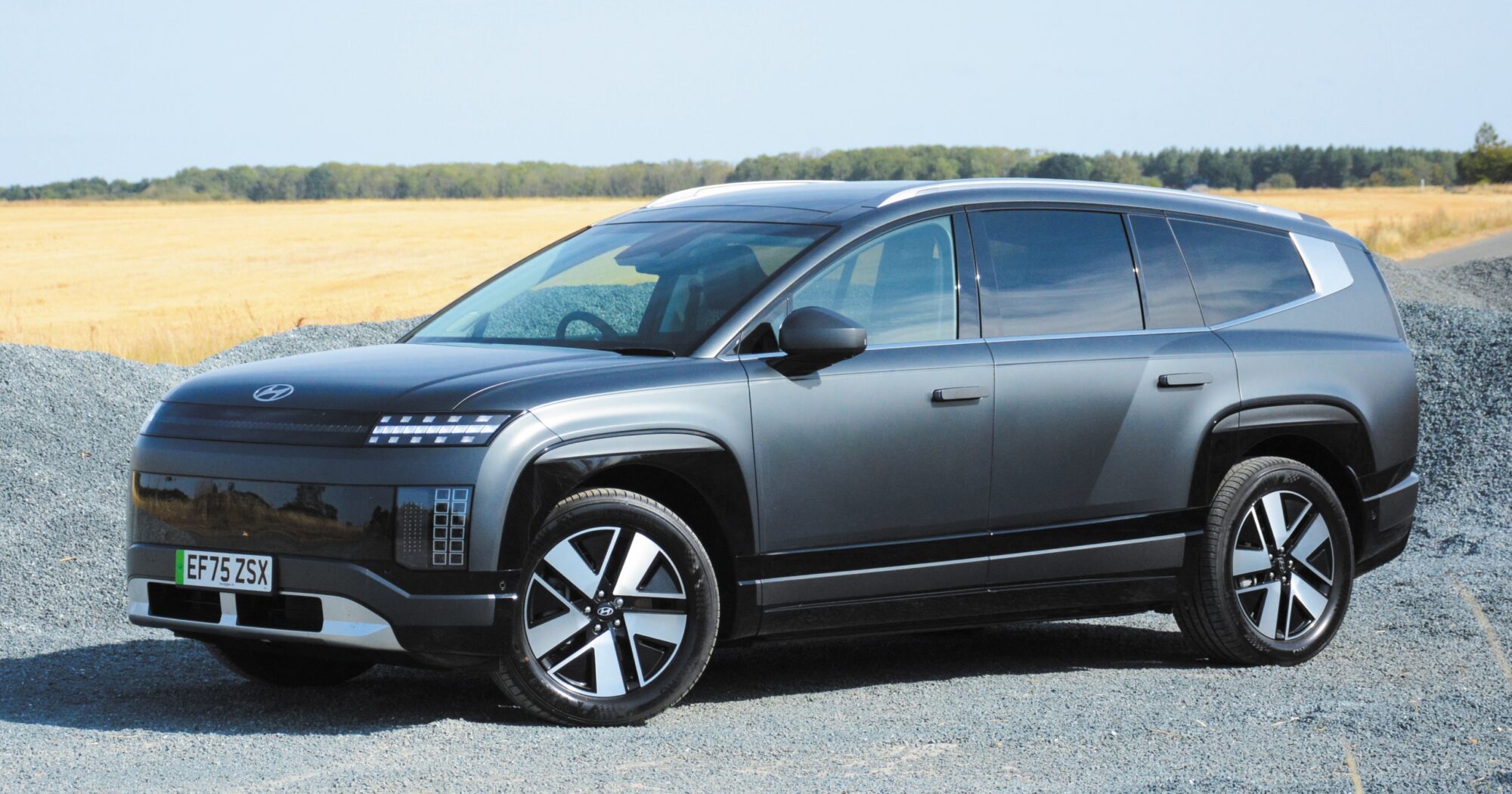
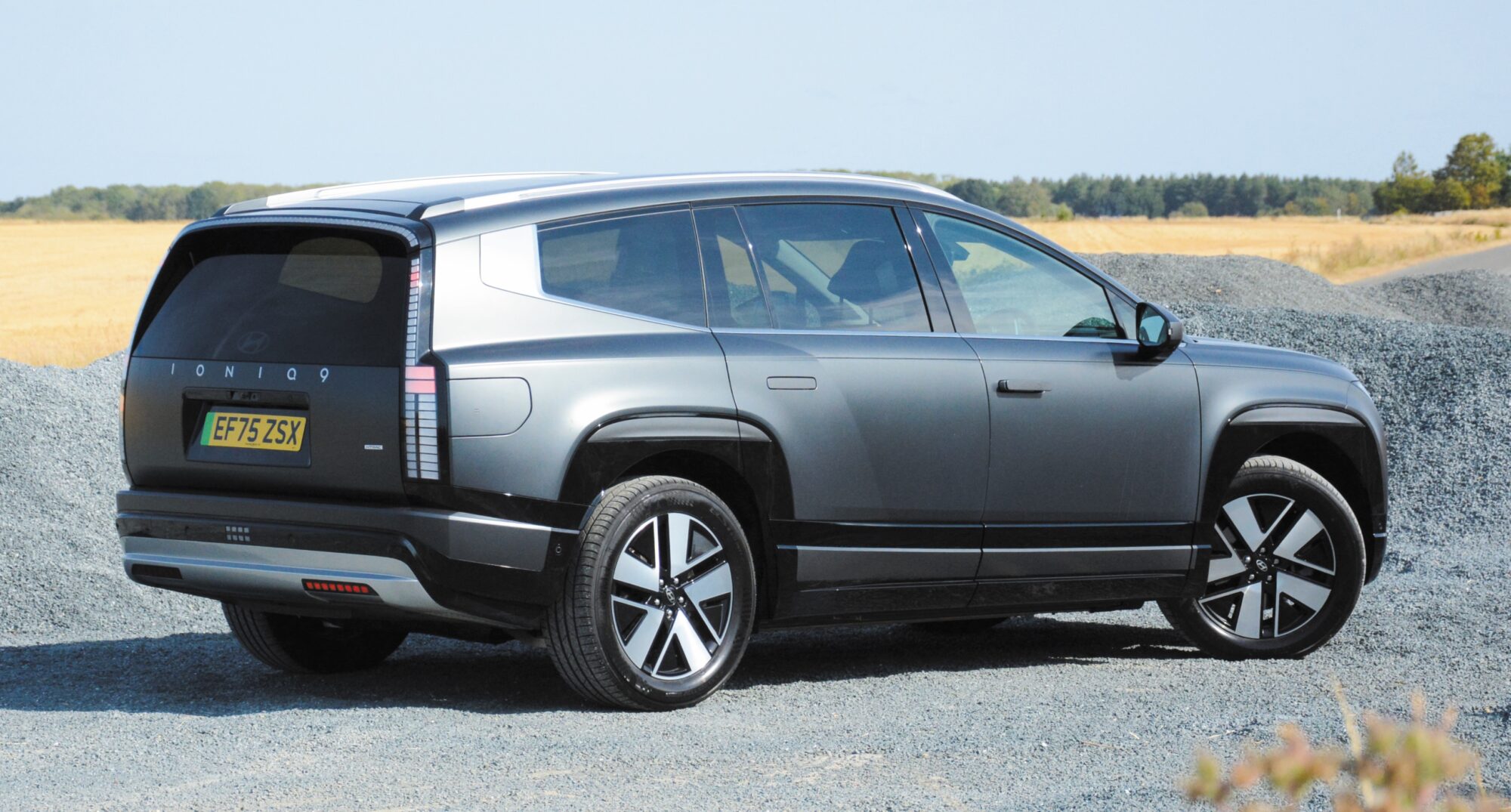
Styling is forever subjective, but love or loathe them, both the Ioniq 5 and 6 look like nothing else on sale. Yet the Ioniq 9, where there’s even more scope to play design-wise, is too generic. Sure, there are some lovely details, particularly how the rear haunches broaden and the rear roofline tapers, all detailed with pixel-esque LEDs, yet overall, it doesn’t seem as radical or special. Perhaps the £1,250 optional Nocturn Grey matte paint didn’t do it any favours – ‘hearse’ was mentioned in a few social media responses to pictures of it – as it creates little contrast from the glossy black exterior trim. It’s available in a handful of hues which generate more visual drama.
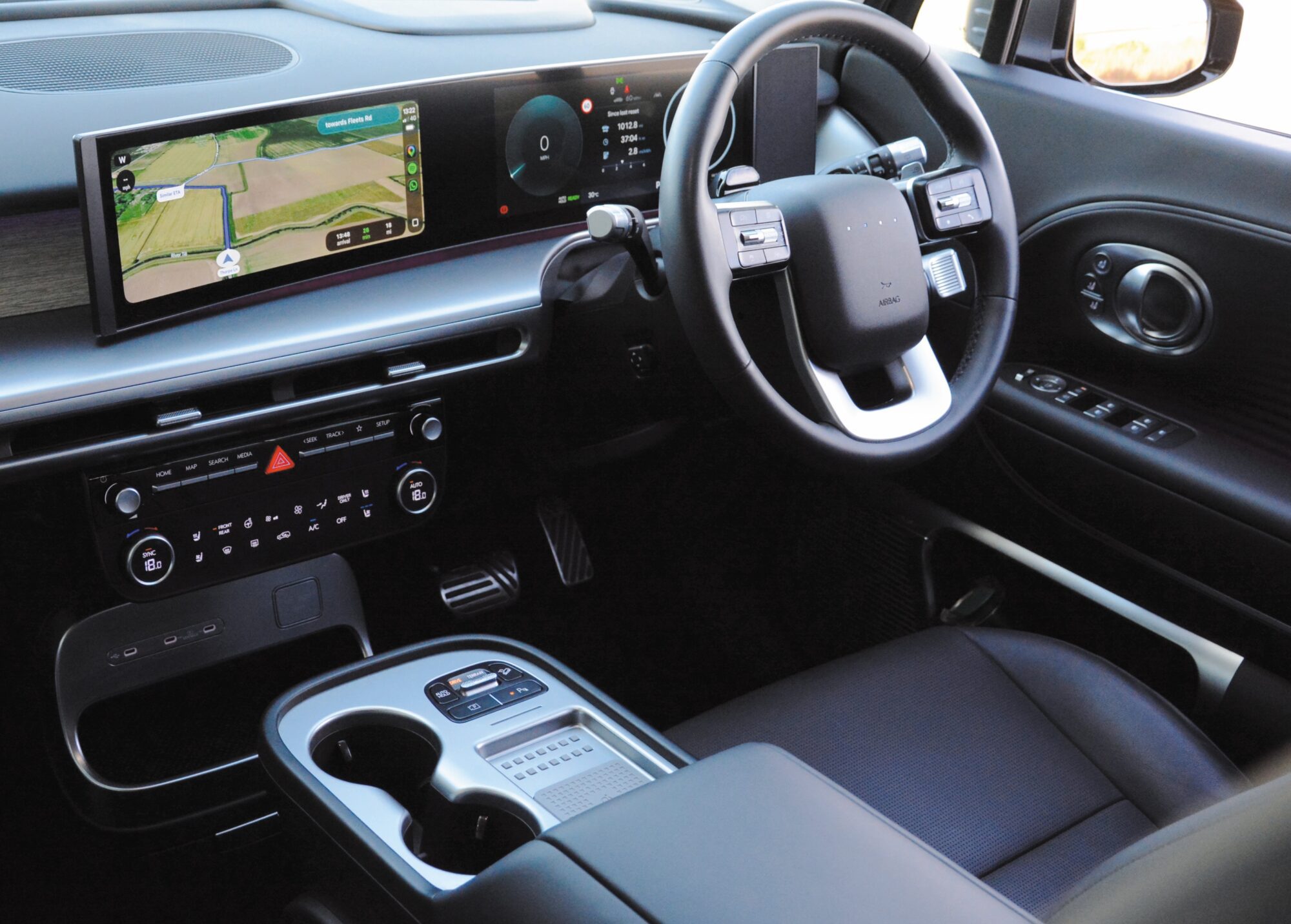
It’s a similar story inside where the seats, door panels and other plastic structures are relentlessly black. Somehow that darkness seems to amplify that the silver- painted mouldings and trim finishes most definitely aren’t metallic in a way that the two-tone pale grey and black somehow complements. However, that plastickiness feels like an example of where costs have been pared-back for the Ioniq 9. And that’s a shame because in terms of construction and capaciousness, its interior is otherwise triumphant. Clear, easy to use dashboard screenage, intuitive physical controls, generous interior storage for in-car detritus. The fact that the deep central console is double-hinged so that those in the second row can dip in and out without troubling those up front is an underrated touch, plus there’s an embarrassment of cupholder provision for all three rows. Its middle-row three-seater bench is particularly palatial when slid all the way rearwards, which is fine when the Ioniq 9’s used predominantly as a five-seater, but they will need pulling forwards when adults are sat aft of them.
While grown-ups can fit in the third-row, with reasonably unobstructed access when the middle-row sections are tipped forwards, the seatback and cushion are short on comfort and substance. If you regularly ferry seven adults around, it might be worthwhile waiting for the Hyundai Staria to finally reach the UK later this year.
Folding and raising the rear seats is a doddle, with quick-release levers and boot wall-mounted push buttons making it a chore-free endeavour, with near-van levels of capacity and a virtually flat floor, making loading the Ioniq 9 with even more Ikea flatpackery no trouble at all, as I found out to my literal cost.
Hyundai has understandably tuned the Ioniq 9’s handling characteristics for long-distance comfort, albeit seemingly oriented to a North American understanding of the term. It tends to feel floaty over undulating surfaces, as though it’s fitted with air springs, despite not being, while corners are approached with faith rather than feel. It just needs to feel a bit more connected to the road, albeit not at the expense of telegraphing road surface imperfections to seven posteriors.
You know the traction’s there, especially with a dual-motor set-up as this one has, but there’s precious little chatter through the steering to let you know. Don’t bother engaging Sport mode, as the whole package is more coherent when left in Normal. Where the Ioniq 9’s steering proves more challenging is in low-speed manoeuvres. It doesn’t help that this is a 5,060mm-long land yacht, but it would have been possible to trim down its almost-12.5-metre turning circle if all- wheel steering had been engineered into its platform design. For reference, Volvo quotes 11.8-metres for the EX90 to perform a complete turn.
With 303bhp and 446lb ft of urgency at your right foot’s disposal, the Ioniq 9 doesn’t feel short of go, as reflected by Hyundai’s 6.7-second 0-62mph claim, but let’s not forget it weighs 2,578kg. The downside is that despite its bodywork’s aerodynamic trickery, this is still a blunt shape with which to cleave the air, resulting in a 2.8 miles/per kWh efficiency average during my month with it, so only 90% of the claimed figure. For reference, Volvo’s Twin Motor EX90 averages a claimed 2.7 to 3.2 miles/ per kWh, yet it produces 146bhp more power. Converted to driving range potential, that’s nearer 339 miles than the official 376-mile tally, meaning it will still cover substantial distances before needing to be plugged in, and potentially a money-saver if you can avoid connecting to expensive ultra-rapid DC chargers out on the road. On occasions that’s necessary, a 10 to 80% recharge is possible in 24 minutes if the energy’s zapped in at its 233kW maximum. So, as comfortable, capacious and capable as an upscale, family-friendly an EV as the Hyundai Ioniq 9 is, those downmarket interior fixtures, its greed for electric energy and its containership-in-a-provincial canal levels of manoeuvrability are detractions limiting it to shortlist status rather than hands-down best of breed.
The thing is, I reckon if Hyundai had spent more time remedying those gripes, making it feel that bit more special as per the smaller Ioniq recipe in the process, the 9 would feel like a winner even at Volvo prices.
KEITH WR JONES
WHAT’S HOT: Masses of space, effortless practicality, performance, cruising comfort.
WHAT’S NOT: Restricted manoeuvrability, disappointing efficiency, some low-rent interior trim.
STANDARD EQUIPMENT: 12.3-inch digital instruments, 20-inch alloy wheels with Kumho PS71 275/50 R20 tyres and tyre repair kit, 50/50 electric split/fold third row seats, 60/40 split/fold second row seats, Active noise cancelling, Adaptive cruise control with stop and go, Alarm system, Ambient lighting, Anti-lock brakes with electronic brake force distribution and brake assist, Auto-dimming rear-view mirror, Automatic headlights, Automated parking system, Autonomous emergency braking system, Blind spot warning system, DAB radio with 12.3-inch touchscreen, navigation, Bose premium audio with 14-speakers and subwoofer, USB-C sockets for all three rows, voice control and steering wheel controls, Digital key, Digital rear view mirror, Driver, passenger, centre, side, head and knee airbags with passenger side de-activation, Driver drowsiness detection, Electric and heated mirrors with power folding and memory, Electric front seats with memory functionality, Electric glass panoramic sunroof, Electric park brake, Electric steering column, Electric tailgate, Electric windows front and rear, Electronic stability programme with traction control, Emergency e-call system, Front and rear skid plates, Head-up display, Heat pump, Heated and ventilated front seats, Heated and ventilated second row seats, Heated steering wheel, Hill start assist, ISOFIX child seat safety fasteners for second row outer and third row seats, Keyless entry and start, Lane follow assist, Lane keep assist, Leather steering wheel, Leather upholstery, LED daytime running lights, LED headlights with adaptive functionality, LED taillights, Metal pedals, Parking sensors front, rear and side, Rain sensing windscreen wipers, Rear privacy glass, Rear cross traffic alert system, Reversing camera, Roof rails, Traffic sign recognition, Trailer stability programme, Tri-zone climate control, Tyre pressure monitors, Vehicle2Load functionality, Wireless Android Auto,Apple CarPlay and Bluetooth smartphone compatibility and Wireless smartphone charger
OPTIONAL EQUIPMENT FITTED TO TEST CAR:
Matte Nocturne Grey metallic (£1,250)
FACTS & FIGURES
PRICE: (NEW) £73,495 (AS TESTED) £74,745
COLOUR: Matte Nocturne Grey metallic
BUILT IN: Ulsan, South Korea
CODENAME: ME
GENERATION: 1
PLATFORM: E-GMP
BODYSTYLE: 5-door SUV, 7-seats
LAYOUT: Four-wheel drive
POWERPLANT: Twin electric motors and 110.3kWh lithium-ion battery pack
GEARBOX: 1-speed automatic
MAX POWER: 226kW/303bhp/307ps
MAX TORQUE: 446lb ft/605Nm
TOP SPEED: 124mph
0-62mph: 6.7secs
CO2 EMISSIONS: 0g/km
ECONOMY (COMBINED): 3.04 miles/kWh
ECONOMY (ON TEST): 2.8 miles/kWh
RANGE (COMBINED): 376 miles
RECHARGE TIME:
AC DOMESTIC SOCKET (10-100%): 44 hours 42 minutes
AC 7.4kW (10-100%): 14 hours 42 minutes
AC 11kW (10-100%): 10 hours
DC 50kW (10-80%): 1 hours 43 minutes
DC 350kW (10-80%): 24 minutes
INSURANCE GROUP: 47
BIK RATE (2026/2027 TAX YEAR): 4%
SIZE (LENGTH/WIDTH WITH MIRRORS/HEIGHT/ WHEELBASE): 5,060/2,251/1,790/3,130mm
BOOT SPACE (7/5/2-SEATS/FRUNK): 338/908/2,419/52 litres
KERB WEIGHT: 2,578kg
TOWING WEIGHT: 2,500kg
EURO NCAP RATING: Five stars
SPARE WHEEL (FULL-SIZE/SPACESAVER/RUN-FLAT/ SELF-SEALING/REPAIR KIT): No/no/no/no/yes
WARRANTY: 5 years/Unlimited miles
DATE ARRIVED: 17th July 2026
COSTS: None
FAULTS: None
© Motorworld Media 2023
Registered Office: 4 Capricorn Centre, Cranes Farm Road, Basildon, Essex. SS14 3JJ
Company Number: 8818356
Website designed by Steve Dawson